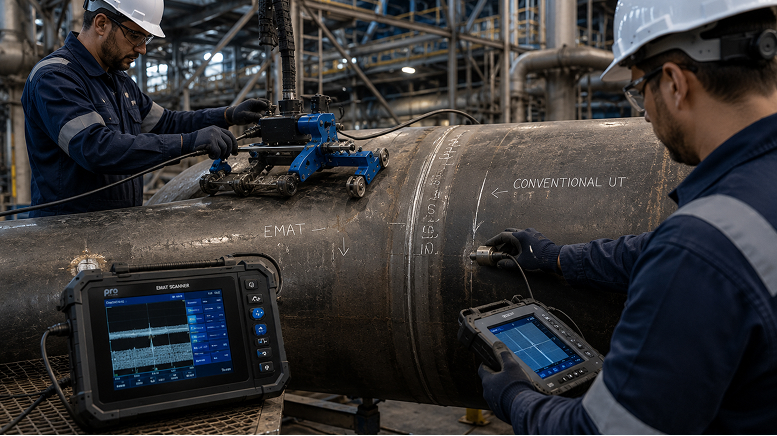
Compare EMAT and conventional ultrasonic testing to understand their key differences, advantages, limitations, applications, and suitability for industrial inspection.
EMAT vs Conventional Ultrasonic Testing: Key Differences, Advantages and Applications
Electromagnetic Acoustic Transducer (EMAT) testing and conventional ultrasonic testing (UT) are both established non-destructive testing (NDT) techniques for examining materials, detecting discontinuities and measuring thickness. The main difference is how ultrasonic waves are introduced into the test material.
Conventional UT generally uses a piezoelectric transducer coupled to the surface, whereas EMAT generates and receives ultrasonic waves through electromagnetic interaction with a conductive material. This fundamental difference affects surface preparation, couplant requirements, temperature tolerance and application suitability.
For industrial inspection teams, therefore, the question is not simply whether EMAT is better than conventional UT. The more useful question is which technique is better suited to the material, surface condition, temperature, accessibility and inspection objective?
What Is EMAT Ultrasonic Testing?
EMAT stands for Electromagnetic Acoustic Transducer. It is an ultrasonic inspection technique in which electromagnetic fields generate and receive acoustic waves within electrically conductive materials.
Unlike conventional contact UT, EMAT does not require a liquid or gel couplant to transmit ultrasonic energy into the material. This makes it particularly useful where conventional probe coupling is inconvenient or difficult, including applications involving hot, rough or coated surfaces.
EMAT technology can be applied to thickness measurement, corrosion assessment and other industrial inspection tasks. However, it requires suitable conductive materials and specialised instrumentation, so its application should be determined by the inspection procedure and material characteristics rather than by the technology alone.
What Is Conventional Ultrasonic Testing?
Conventional ultrasonic testing uses high-frequency sound waves to examine the internal structure of a component. A piezoelectric transducer converts electrical energy into ultrasonic waves and receives returning echoes from interfaces or discontinuities within the material.
For contact inspection, a couplant is normally applied between the probe and test surface to facilitate transmission of ultrasonic energy. The returning signals are then interpreted to determine information such as wall thickness, reflector location and discontinuity characteristics.
Conventional UT remains one of the most versatile NDT methods. It is widely used for weld inspection, corrosion monitoring, thickness measurement and evaluation of components across manufacturing, aerospace, oil and gas, power generation and other industrial sectors.
EMAT vs Conventional Ultrasonic Testing: What Is the Difference?
The most significant distinction is the method used to couple ultrasonic energy into the material.
Inspection factor | EMAT | Conventional UT |
Couplant | Generally not required | Normally required for contact testing |
Surface preparation | Can be advantageous on rough or coated surfaces | Surface condition can affect coupling |
Hot surfaces | Particularly suitable for some high-temperature applications | Temperature limitations depend on probe, couplant and procedure |
Material | Requires electrically conductive material | Applicable to a broad range of materials |
Probe contact | Non-contact or near-contact operation | Typically direct contact |
Inspection flexibility | Useful for specialised applications | Highly versatile and widely established |
Equipment | Requires specialised EMAT instrumentation | Broad range of conventional UT equipment available |
Typical uses | Corrosion, thickness and specialised inspection | Thickness, welds, flaws and general UT inspection |
This comparison should be viewed as an application-specific assessment rather than a universal measure of one technology’s superiority. Inspection performance depends on equipment configuration, material properties, test conditions, calibration and operator competence.
Does EMAT Require Couplant?
No. EMAT is generally a couplant-free ultrasonic technique. Instead of relying on direct acoustic coupling through a liquid or gel, electromagnetic fields interact with the conductive test material to generate ultrasonic waves.
This is one of EMAT's most important practical advantages. Eliminating couplant can simplify inspections where applying and maintaining a consistent coupling layer would be difficult. It can also make the technique attractive for surfaces that are hot, rough or coated.
Conventional contact UT, by comparison, normally relies on couplant to transmit sound efficiently between the transducer and test surface.
What Are the Advantages of EMAT Over Conventional UT?
EMAT can offer several practical advantages when the application matches its operating principles.
Couplant-free inspection is particularly valuable where conventional coupling is inconvenient. The inspection process can become less dependent on maintaining a consistent liquid or gel layer.
Hot-surface inspection is another important application area. ASNT identifies EMAT as suitable for high-temperature inspections, although the actual operating limits depend on the equipment, material and procedure being used.
Rough or coated surfaces can also present fewer coupling challenges. Conventional UT may become more difficult when surface condition interferes with probe contact, whereas EMAT can be advantageous in such circumstances.
EMAT can therefore be particularly attractive for industrial assets where surface preparation, temperature or access makes conventional contact UT less practical.
What Are the Limitations of EMAT Testing?
EMAT is not a universal replacement for conventional ultrasonic testing.
The technique depends on electromagnetic interaction with the test material, meaning material conductivity is an important consideration. Its specialised instrumentation and probe requirements can also make implementation more application-specific than conventional UT.
Probe configuration, lift-off, material properties, frequency and inspection conditions can influence results. Consequently, an EMAT system should be selected and configured according to a documented inspection procedure rather than simply replacing a conventional UT instrument.
Conventional UT also has a major advantage in maturity and versatility. A broad range of probes, wedges, frequencies and inspection configurations are available, and the method is extensively established across industrial NDT applications.
EMAT vs Conventional UT for Corrosion and Thickness Measurement
Both methods can support corrosion monitoring and wall-thickness measurement, but their suitability can differ according to the inspection environment.
Conventional ultrasonic thickness testing is widely used to measure the thickness of components and monitor material loss. It provides a practical solution when the surface is accessible and suitable for probe coupling.
EMAT becomes particularly interesting when the surface is hot, coated or difficult to couple. ASNT identifies EMAT among techniques used for corrosion detection and thickness measurement.
For pipelines, tanks, pressure equipment and other industrial assets, the selection should consider more than nominal measurement accuracy. Surface condition, temperature, accessibility, material type, required inspection speed and applicable procedures should all be evaluated.
When Should You Choose EMAT Instead of Conventional Ultrasonic Testing?
EMAT may be the better option when:
The test surface is hot or difficult to access safely.
Couplant application is impractical.
The surface is rough or coated.
The material is electrically conductive and compatible with the EMAT system.
The inspection requires a specialised couplant-free approach.
Corrosion or thickness measurement is required under challenging surface conditions.
Conventional UT may be preferable when:
The surface is readily accessible and suitable for coupling.
A wide range of established probes and techniques is required.
The material or application is not suitable for EMAT.
Conventional thickness or flaw detection procedures already meet the inspection requirement.
Existing personnel, equipment and procedures are built around conventional UT.
In many industrial programmes, EMAT and conventional UT should be viewed as complementary technologies rather than competing methods.
Which Ultrasonic Testing Method Is Right for Your Application?
The right choice depends on the inspection objective and operating environment. Before purchasing equipment, inspection teams should assess:
Material: Is the component electrically conductive and compatible with EMAT?
Surface condition: Is it smooth, rough, oxidised, painted or coated?
Temperature: Can the surface be inspected using conventional contact UT safely and reliably?
Access: Can the probe be positioned and maintained consistently?
Measurement objective: Is the requirement thickness measurement, corrosion monitoring or flaw detection?
Procedure: What codes, standards, calibration requirements and acceptance criteria apply?
Operator capability: Does the inspection team have the required training and experience?
Equipment suitability: Does the selected instrument provide the required measurement range, probes and data capabilities?
A technically appropriate instrument should support the inspection procedure rather than dictate it.
Conclusion
EMAT vs conventional ultrasonic testing is ultimately a question of application suitability rather than technological superiority. Conventional UT remains a dependable and versatile method for thickness measurement and flaw detection, while EMAT provides distinct advantages where couplant-free operation, hot surfaces or challenging surface conditions are important.
For industrial inspection professionals, the best approach is to define the inspection requirement first and then select the technology, probe and procedure that can meet it reliably. Proper calibration, qualified personnel, appropriate equipment and a clearly defined inspection procedure remain essential regardless of which ultrasonic technique is selected.
This application-led approach helps organisations obtain meaningful inspection data while supporting asset integrity, corrosion management, predictive maintenance and long-term operational reliability.