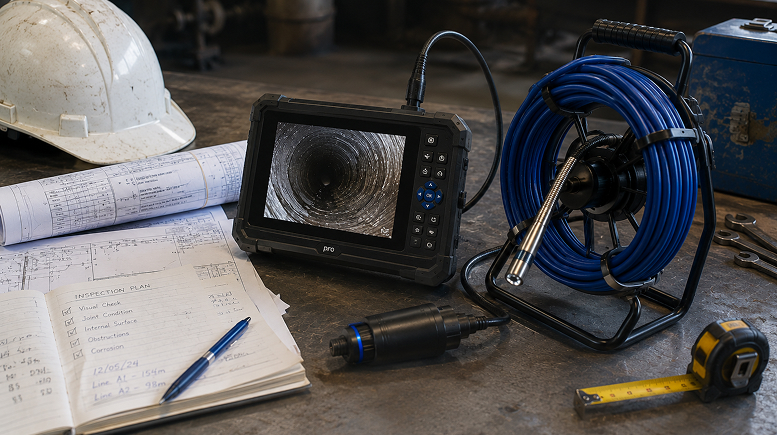
Learn how to choose the right pipe inspection camera by comparing camera types, essential features, industry applications, and key buying factors to improve inspection accuracy, operational efficiency, and long-term asset integrity.
Pipe Inspection Camera Buying Guide: How to Choose the Right System for Industrial Inspection
Industrial pipelines form the backbone of operations across oil and gas, pharmaceuticals, power generation, municipal utilities, water treatment, manufacturing, and infrastructure projects. Inspecting these systems efficiently is essential for maintaining operational continuity, ensuring regulatory compliance, and preventing costly failures. Modern pipe inspection cameras enable engineers to examine internal pipe conditions without dismantling equipment, making them indispensable tools for predictive maintenance and non-destructive testing (NDT).
However, selecting the right pipe inspection camera involves far more than comparing prices or choosing the highest camera resolution. Factors such as pipe diameter, inspection distance, environmental conditions, articulation, illumination, portability, and reporting capabilities all influence inspection accuracy and long-term return on investment. This guide explains how industrial professionals can select the most appropriate pipe inspection camera while highlighting the specialised inspection solutions offered by Pro Engineers.
Why Pipe Inspection Cameras Matter
Traditional inspection methods often require excavation, dismantling, or prolonged shutdowns before defects become visible. Modern pipe inspection cameras eliminate these limitations by providing real-time visual access to internal pipe surfaces, allowing maintenance teams to identify corrosion, scaling, cracks, weld imperfections, blockages, leakage points, deposits, and mechanical wear before they develop into major operational failures.
Industries increasingly rely on remote visual inspection because it reduces maintenance costs, minimises production downtime, improves worker safety, and supports data-driven asset integrity management.
Define Your Inspection Application First
The first step in selecting an inspection camera is understanding the intended application. Different industries require different inspection capabilities.
Municipal corporations typically inspect sewer lines, drainage systems, water distribution pipelines, and underground utility networks.
Oil and gas operators require inspection systems capable of evaluating process pipelines, pressure systems, storage facilities, and transmission infrastructure.
Thermal power plants inspect boiler tubes, condensers, heat exchangers, cooling water pipelines, and auxiliary piping.
Pharmaceutical manufacturers require high-resolution inspection systems capable of verifying process cleanliness while supporting GMP compliance.
Selecting equipment based on the operating environment always produces better long-term performance than choosing equipment based solely on specifications or price.
Consider Pipe Diameter and Inspection Distance
Pipe dimensions significantly influence equipment selection.
Small-diameter pipelines require compact camera heads capable of navigating confined internal passages without compromising image quality.
Medium-sized industrial process lines generally benefit from portable push-rod inspection systems offering greater flexibility and operational simplicity.
Large municipal sewers and long-distance pipelines often require robotic crawler inspection systems capable of travelling extended distances while maintaining image stability.
Before purchasing any inspection camera, determine:
Minimum pipe diameter
Maximum inspection distance
Number of bends and junctions
Vertical or horizontal inspection requirements
Accessibility of inspection points
These parameters help identify the most appropriate inspection platform.
Evaluate Image Quality Beyond Resolution
Many buyers assume that higher resolution alone guarantees better inspection performance. In practice, inspection accuracy depends on the complete imaging system.
Key considerations include:
High-definition image sensor
Adjustable LED illumination
Wide viewing angle
Digital zoom capability
Stable image processing
Accurate colour reproduction
Low-light performance
These capabilities enable the accurate detection and assessment of corrosion, cracking, pitting, weld discontinuities, scale accumulation, foreign object debris (FOD), and other forms of structural degradation, supporting informed maintenance decisions and enhanced asset integrity.
Choose the Right Inspection System
Different inspection environments require specialised equipment.
Robotic Pipe Inspection Camera
Robotic systems are designed for long-distance inspections within municipal pipelines, sewer networks, large industrial process lines, and underground infrastructure. Their motorised mobility enables comprehensive inspection of extensive pipeline systems while reducing operator fatigue.
Manual Pipe Inspection Camera
Portable manual pipe inspection systems provide an efficient and versatile solution for the routine inspection of small-diameter pipelines, building services, industrial process piping, and maintenance operations that require rapid deployment, operational flexibility, and reliable visual diagnostics.
Industry-Specific Inspection Cameras
Pro Engineers also offers specialised inspection solutions developed for specific operational environments, including:
Pro-H2-C23 HD Pipe Inspection Camera
Pro-A1-C23 Portable Pipe Inspection Camera
Pro-A2-C23L Pharma Plant Pipe Inspection Camera
Pro-VW10-2388 PTN-1 Industrial Pipe Inspection Camera
Pro-FH1-C28PT Thermal Power Plant Pipe Inspection Camera
Pro-I11-B360-C50 AHD Underwater Inspection Camera
Pro-L1 Telescopic Inspection Camera
Pro-BI40 Borewell Inspection Camera
Each solution is engineered to address the inspection requirements of specific industries rather than adopting a one-size-fits-all approach.
Essential Features to Compare Before Buying
When evaluating industrial pipe inspection cameras, compare equipment using operational requirements rather than marketing specifications.
Important evaluation criteria include:
Camera head diameter
Cable length
Waterproof protection
HD image quality
LED lighting
Push-rod flexibility
Articulation capability
Recording and image capture
Battery operating time
Monitor size
Portable control unit
Inspection reporting functionality
Service support
Spare part availability
Selecting equipment that aligns with operational requirements ensures lower lifecycle costs and improved inspection efficiency.
Industry-Specific Buying Recommendations
Municipal Infrastructure
Choose robotic inspection cameras capable of surveying long sewer networks, drainage systems, and underground utility pipelines with reliable mobility and extended operating distances.
Oil and Gas
Select rugged inspection systems designed for demanding operating environments where corrosion monitoring, weld inspection, and internal pipeline assessment are essential.
Pharmaceutical Manufacturing
Inspection systems should provide high-definition imaging capable of verifying pipeline cleanliness and supporting stringent quality assurance procedures.
Thermal Power Plants
Inspection cameras should accommodate boiler tubes, condensers, heat exchangers, and cooling water systems while delivering clear visual documentation under challenging operating conditions.
Common Buying Mistakes
Many organisations reduce procurement decisions to equipment cost alone. This approach frequently results in selecting systems that fail to meet operational requirements.
Common purchasing mistakes include:
Selecting the lowest-priced system
Ignoring pipe diameter compatibility
Underestimating required cable length
Choosing insufficient image quality
Overlooking waterproof protection
Ignoring after-sales service availability
Purchasing equipment without considering future inspection requirements
A structured procurement process should always balance technical performance, reliability, maintainability, and lifecycle value.
Why Industrial Professionals Choose Pro Engineers
Pro Engineers supplies advanced industrial inspection equipment designed for demanding inspection environments across India. Its portfolio includes specialised pipe inspection cameras for municipal infrastructure, industrial manufacturing, oil and gas, pharmaceutical production, thermal power generation, water utilities, and underground asset management.
Rather than delivering one-size-fits-all inspection solutions, Pro Engineers provides application-specific inspection systems supported by technical expertise. This consultative approach enables organisations to select equipment that addresses their operational requirements, inspection challenges, and long-term asset maintenance objectives with greater precision and confidence.
Final Buying Checklist
Before purchasing a pipe inspection camera, confirm the following:
Define the inspection application.
Identify pipe diameter and inspection distance.
Select the appropriate camera type.
Evaluate image quality and illumination.
Verify waterproof and environmental ratings.
Confirm recording and reporting capabilities.
Assess portability and ease of operation.
Review technical support and after-sales service.
Consider long-term maintenance requirements.
Choose a trusted industrial inspection equipment supplier.
Conclusion
A pipe inspection camera represents a strategic investment in asset reliability, operational efficiency, and preventive maintenance. The most suitable solution is determined not by its price or specification sheet alone, but by its ability to address the operational challenges of the intended inspection environment.
Whether inspecting municipal sewer networks, industrial process pipelines, pharmaceutical production lines, thermal power infrastructure, or underground utility systems, selecting an application-specific inspection camera improves diagnostic accuracy, reduces maintenance costs, and extends asset life. By partnering with an experienced supplier such as Pro Engineers, industrial professionals can invest in inspection technology that delivers measurable operational value while supporting safe, efficient, and data-driven infrastructure management.