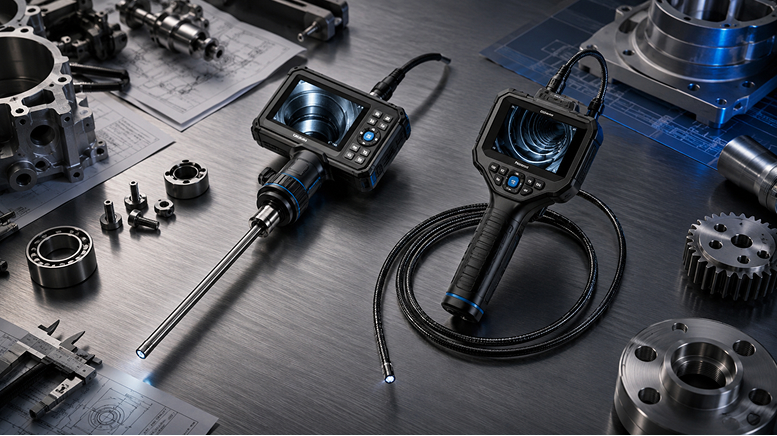
Compare rigid and flexible borescopes to choose the ideal solution for industrial inspection and NDT applications.
Rigid vs Flexible Borescopes: Which Inspection Solution Is Right for Your Industrial Application?
Industrial inspection has evolved significantly with the advancement of Remote Visual Inspection (RVI) and Non-Destructive Testing (NDT) technologies. Among the most widely used inspection tools are Rigid Borescopes and Flexible Borescopes, both designed to inspect inaccessible areas without dismantling machinery or interrupting operations. Although they serve a common purpose, their design, capabilities, and applications differ considerably.
Selecting the appropriate borescope directly influences inspection accuracy, maintenance efficiency, equipment reliability, and operational costs. Industries such as oil and gas, power generation, aerospace, automotive manufacturing, pharmaceuticals, petrochemicals, and heavy engineering rely on the right inspection technology to identify internal defects before they develop into costly failures.
This comprehensive guide compares Rigid vs Flexible Borescopes, explains their advantages and limitations, and provides practical recommendations to help engineers, maintenance professionals, and quality assurance teams select the most suitable inspection solution.
What is a Rigid Borescope?
A Rigid Borescope is a precision optical inspection instrument featuring a straight, inflexible insertion tube equipped with high-quality lens systems that transmit exceptionally clear images from inaccessible locations. Since the optical pathway remains fixed, rigid borescopes deliver outstanding image resolution, colour fidelity, and dimensional accuracy.
Rigid borescopes are ideally suited for inspecting components that offer direct access, including engine cylinders, turbine blades, precision machined parts, mould cavities, injection systems, bearings, weld joints, and manufacturing assemblies. Their durable construction also makes them well suited for demanding industrial environments where robustness and repeatable performance are essential.
Because they contain fewer moving components than flexible systems, rigid borescopes generally require less maintenance while providing consistently superior optical performance during routine quality inspections.
What is a Flexible Borescope?
A Flexible Borescope, commonly referred to as a Videoscope, incorporates a flexible insertion tube capable of navigating curved pathways, confined spaces, and complex internal geometries. Modern systems feature high-definition digital cameras, LED illumination, articulation controls, image capture, video recording, and advanced reporting capabilities.
Flexible borescopes enable inspectors to access areas that would otherwise require extensive equipment disassembly. They are extensively used for inspecting heat exchangers, pipelines, boilers, condensers, aircraft engines, turbines, process vessels, pharmaceutical equipment, and industrial piping systems.
Their exceptional manoeuvrability allows maintenance engineers to detect corrosion, cracking, foreign object debris, weld imperfections, scaling, erosion, deposits, and internal damage while significantly reducing inspection time and operational disruption.
Rigid vs Flexible Borescopes: A Detailed Comparison
Feature | Rigid Borescope | Flexible Borescope |
Construction | Straight rigid tube | Flexible insertion tube |
Accessibility | Straight inspection paths | Straight and curved pathways |
Image Quality | Exceptional optical clarity | Excellent HD digital imaging |
Articulation | Not available | Available in multiple directions |
Portability | Compact and lightweight | Portable with integrated display |
Inspection Reach | Limited by straight access | Extended reach in confined spaces |
Maintenance | Minimal | Moderate |
Typical Cost | Lower | Higher |
Best Applications | Precision manufacturing | Complex industrial inspections |
The choice depends less on which technology is superior and more on which inspection environment is involved. Rigid borescopes excel where unobstructed access and optical precision are required, whereas flexible borescopes provide unmatched versatility in complex industrial systems.
Advantages of Rigid Borescopes
Rigid borescopes remain the preferred choice whenever direct-line inspection is possible. Their superior optical performance makes them invaluable for quality control, dimensional verification, and defect detection in manufacturing environments.
Key advantages include:
Exceptional image resolution
High optical accuracy
Durable construction
Lower maintenance requirements
Cost-effective ownership
Reliable performance for repetitive inspections
These characteristics make rigid borescopes particularly valuable in precision engineering and production inspection applications.
Advantages of Flexible Borescopes
Flexible borescopes provide access where rigid systems cannot operate. Their articulating probes and digital imaging systems allow engineers to inspect long, curved, or obstructed passages without dismantling expensive equipment.
Major benefits include:
Inspection of curved pipelines
Articulating camera control
HD image and video recording
Minimal equipment disassembly
Faster maintenance planning
Reduced operational downtime
Their versatility has made them indispensable across predictive maintenance and asset integrity programmes.
Industry Applications
Oil & Gas
Flexible borescopes are extensively employed for the non-destructive inspection of process piping, pressure vessels, valves, compressors, heat exchangers, and refinery equipment operating under severe process conditions, enabling accurate internal defect detection while minimizing equipment disassembly and operational downtime.
Thermal Power Plants
Both rigid and flexible borescopes support inspections of boiler tubes, condensers, turbines, steam lines, and heat exchangers to improve equipment reliability.
Aerospace
Aircraft maintenance engineers rely predominantly on flexible borescopes to inspect turbine engines, combustion chambers, compressors, and inaccessible structural components.
Automotive Manufacturing
Rigid borescopes are widely employed for inspecting engine blocks, cylinder bores, fuel systems, castings, and machined components during production.
Pharmaceutical Industry
Flexible borescopes assist in inspecting hygienic process pipelines, reactors, stainless steel tubing, and clean utility systems while minimising production interruptions.
Heavy Engineering
Manufacturers use both technologies for inspecting fabricated structures, weldments, castings, hydraulic systems, and industrial machinery.
How to Choose the Right Borescope
Before selecting an inspection system, organisations should evaluate:
Can the inspection area be accessed in a straight line?
Does the inspection path contain bends or obstructions?
What insertion tube diameter is required?
Is image recording necessary for documentation?
Does the inspection require articulation?
What level of image resolution is required?
Will the equipment operate in harsh industrial environments?
What industry standards and inspection procedures apply?
A structured assessment ensures that the selected borescope aligns with operational requirements, inspection objectives, and long-term maintenance strategies.
Common Mistakes When Selecting a Borescope
Many organisations prioritise acquisition cost over application suitability, often overlooking the operational, technical, and lifecycle requirements that ultimately determine inspection effectiveness and long-term asset performance.
Common selection errors include:
Choosing a rigid borescope for curved inspection paths
Purchasing excessive articulation for straightforward inspections
Ignoring insertion tube diameter limitations
Overlooking lighting requirements
Selecting insufficient image resolution
Failing to consider inspection reporting capabilities
Ignoring environmental operating conditions
Avoiding these mistakes improves inspection efficiency and reduces lifecycle costs.
Conclusion
Rigid and Flexible Borescopes each play a vital role in modern industrial inspection and Non-Destructive Testing (NDT). Rigid borescopes provide unmatched optical precision for straight-line inspections, while flexible borescopes deliver exceptional accessibility for complex internal structures and confined spaces.
The most effective inspection strategy is not choosing one technology over the other but selecting the solution that best matches the asset, inspection environment, and maintenance objective. By investing in the appropriate borescope technology, organisations can strengthen predictive maintenance, improve asset integrity, reduce downtime, and enhance operational safety across critical industrial infrastructure.