EMAT Thickness Gauges
Revolutionary electromagnetic acoustic transducer technology for non-contact ultrasonic thickness measurement. Perfect for high-temperature applications and surfaces with coatings.
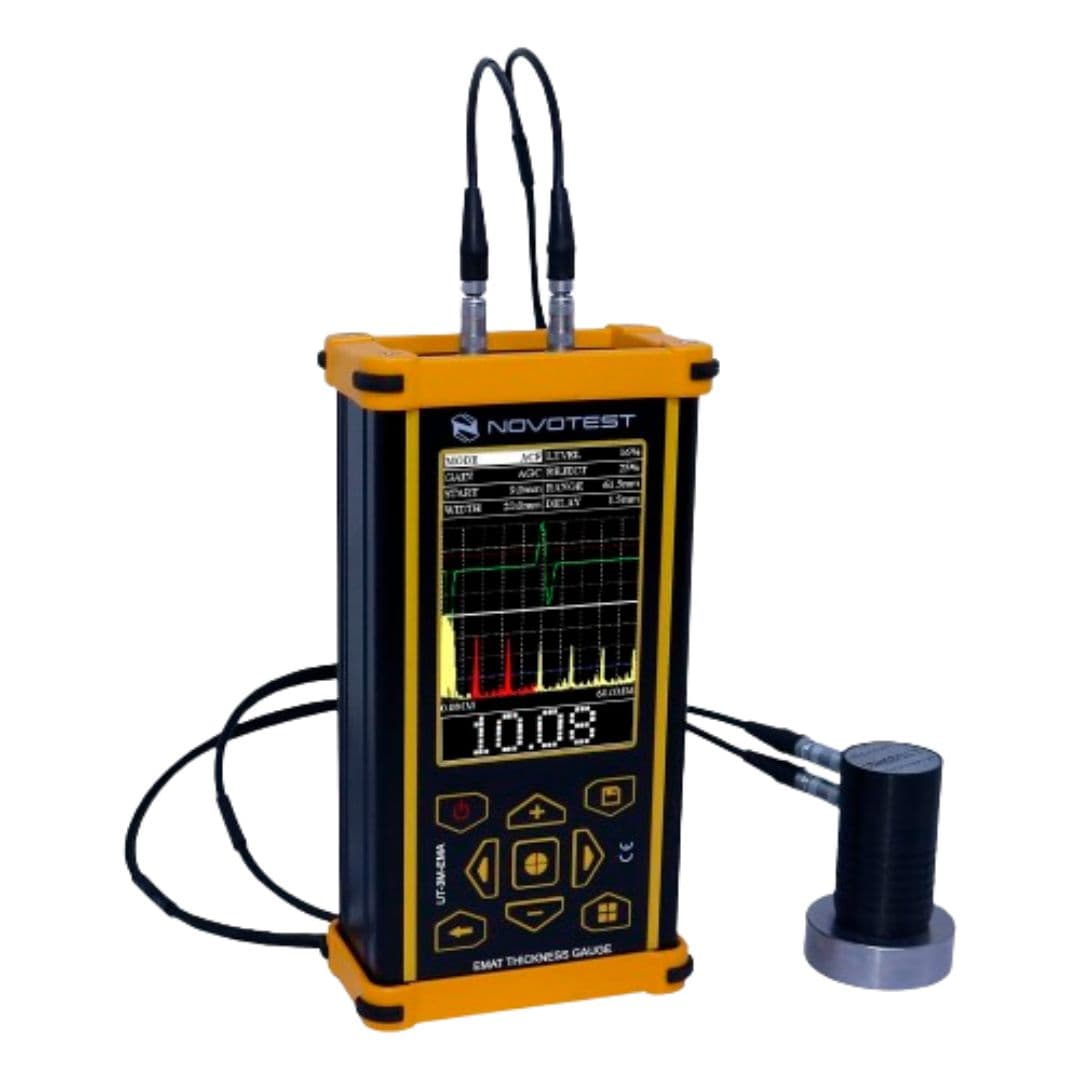
EMAT Thickness Gauge
The EMAT Thickness Gauge is designed for industrial thickness measurement applications where conventional ultrasonic testing may be difficult because of surface conditions, high temperatures or the need for specialised inspection. Using electromagnetic acoustic transducer technology, it enables thickness measurement without requiring conventional liquid couplant in suitable applications. It is particularly relevant to industrial facilities that need to assess metal thickness, corrosion and material degradation during maintenance and inspection activities. The EMAT-A1 configuration offers automatic measurement, B-scan visualisation and thickness-limit control. Its published specifications include a measurement range of 3–300 mm in steel, a maximum operating temperature of 500°C and an accuracy of ±0.1 mm or ±1%, whichever is greater. Actual measurement capability depends on the probe, material properties and inspection conditions. For Indian industries such as steel manufacturing, power generation, petrochemicals, refineries and heavy engineering, EMAT technology can be considered for specialised thickness measurement and corrosion assessment. The B-scan function provides a visual representation of the inspected material, while thickness-limit control helps identify measurements outside defined limits. These functions can support inspection documentation and maintenance planning. When comparing an EMAT Thickness Gauge with a conventional ultrasonic thickness gauge, buyers should evaluate surface preparation requirements, operating temperature, material characteristics, measurement range and inspection accessibility. EMAT technology is not suitable for every material or inspection condition, so application-specific technical evaluation is important before purchasing.
- EMAT-Based Thickness Measurement Through Challenging Surface Conditions: The NOVOTEST EMAT-A1 uses electromagnetic acoustic transducer technology to measure metal thickness through rust and compatible coatings and air gaps. It enables inspection where conventional contact-based ultrasonic measurement may require additional surface preparation or prove difficult to perform.
- Compatibility with Existing Ultrasonic Flaw Detectors: Designed as an active EMAT transducer the EMAT-A1 extends the capabilities of compatible ultrasonic flaw detectors and thickness gauges. It connects in place of a conventional piezoelectric probe when the instrument supports the required A-scan and bipolar excitation signal. This allows inspection teams to introduce EMAT measurement capability without necessarily investing in an entirely separate instrument.
- Thickness Profiling Through Controlled Surface Scanning: When fitted with the optional probe carriage the EMAT-A1 can scan elongated metal components and generate a profile of thickness variations. This supports the assessment of wall-thickness changes along selected inspection paths and helps identify areas that require further investigation.
- Autonomous Power Supply and Automatic Operation: The active transducer operates using replaceable rechargeable AA or compatible 14500 batteries. Its automatic activation and shutdown in response to excitation pulses from the connected flaw detector simplify operation and eliminate the need for separate manual power control.
About this category
Revolutionary electromagnetic acoustic transducer technology for non-contact ultrasonic thickness measurement. Perfect for high-temperature applications and surfaces with coatings.
EMAT Technology Advantages
No Couplant Required
EMAT technology eliminates the need for liquid couplant, making measurements faster and cleaner, especially on vertical or overhead surfaces.
High Temperature Capability
Measure thickness on surfaces up to 500°C without cooling, ideal for online monitoring in industrial processes.
Through Coating Measurement
Accurately measure base material thickness through paint, rust, or other coatings without surface preparation.
Non-Contact Operation
Small air gap between transducer and surface allows measurement without physical contact, reducing wear and contamination.